Why AI labs are rethinking Git, and why most teams can wait
OpenAI scaled Git with Pando. Anthropic replaced it with Scion. Their unusual workloads offer lessons for ordinary development teams, without demanding a migration.
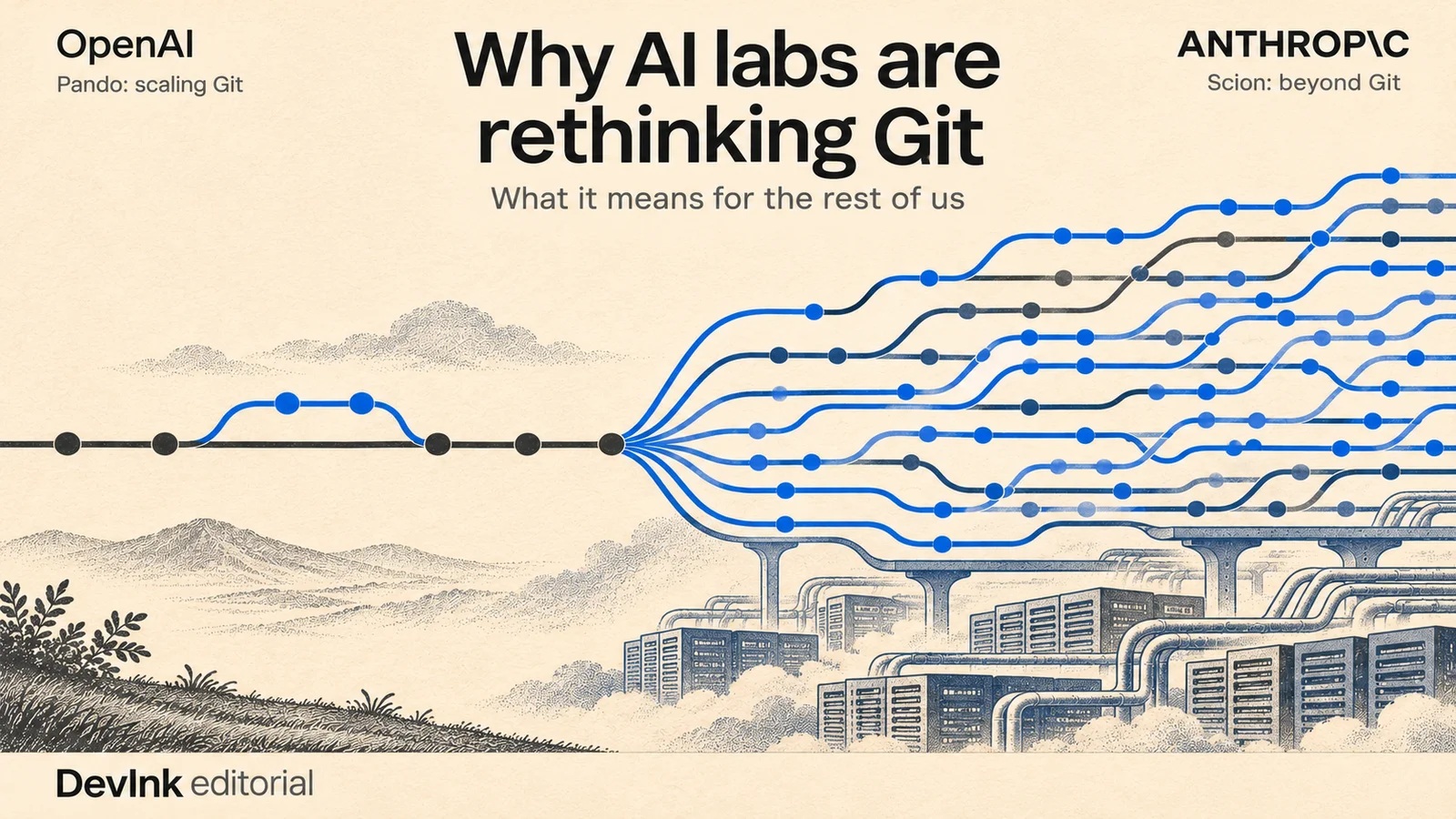
OpenAI and Anthropic are reworking source control as coding agents multiply branches, pushes and CI checkouts. But they have made different choices, and neither story means ordinary developers need to leave Git behind.
Same pressure, different answers
In its November 2 post, OpenAI describes Pando, a new backend that retains Git compatibility. It handles pushes to separate branches independently and reuses stored bundles of Git data across downloads. OpenAI reports cutting median push latency by nearly 80%.
Anthropic's October 13 post describes a bigger departure: Scion, its own version-control system. The company says it was merging more than 30,000 changes a day by September. Scion assumes clients are online, moves history queries and other work to servers, and fetches only the data clients need. The tradeoff is losing Git's self-contained, offline model and requiring a different toolchain.
The shared problem is the workload around the code. A single engineer can run several agents, and each change can trigger more automated jobs fetching the repository. Infrastructure has to serve that activity, even when the human team hasn't grown.
What should the rest of us do?
For most teams, the practical answer is to keep using Git. If checkouts are fast enough, pushes are reliable and CI isn't overwhelmed, these posts offer no reason to build a replacement. Anthropic itself says Scion is unsuitable as a general-purpose Git replacement.
If agent use grows, measure checkout time, push failures, CI queues and infrastructure spend. Investigate unnecessary full clones, repeated downloads and redundant jobs before considering a new source-control architecture.
The benefit may arrive through familiar tools: OpenAI says some of its client improvements are already in upstream Git. More companies may encounter similar pressures, but that is an expectation, not an established industry-wide migration.
The useful lesson is to respond to measured bottlenecks. Most developers can learn from these systems while continuing to use the Git workflow they already know.